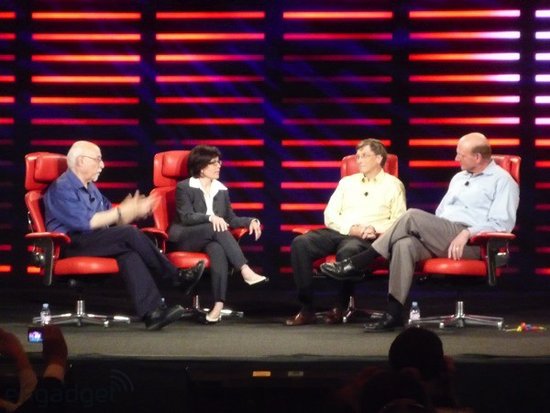
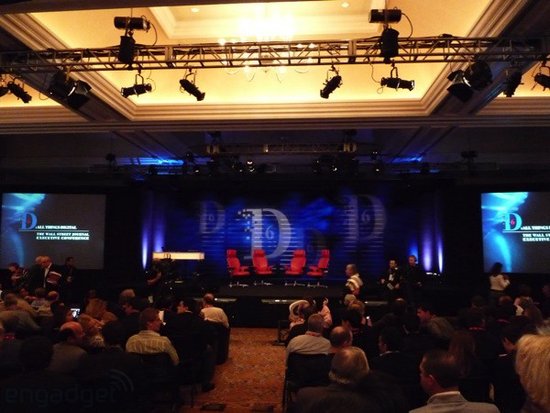
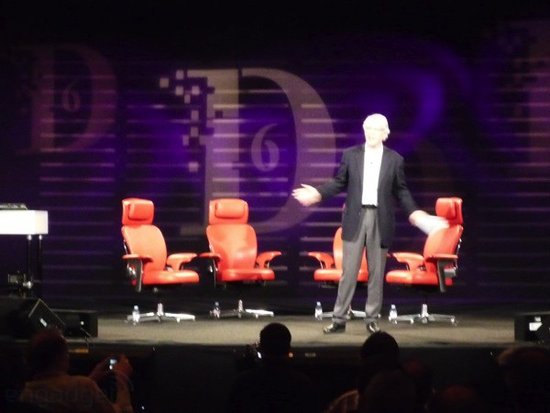
 6:27 - Announcer welcomes Les Hinton, CEO of Dow Jones. Applauding Walt and Kara, discussing the "change in ownership,".
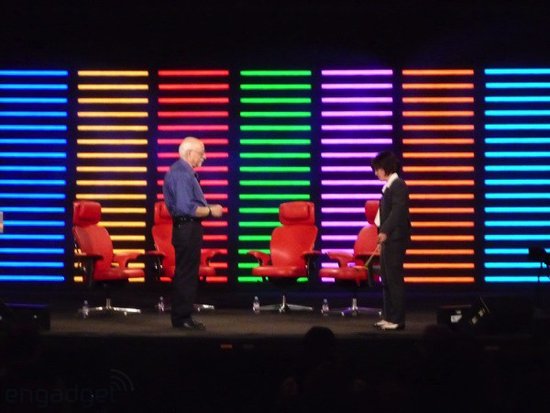 6:30 - Welcoming out Walt and Kara... aaand here they are.
6:31 - Mossberg: "It's been a turbulent year for a lot of these companies." Swisher: "It's been a big news year." Indeed it has.
6:36 - They want to have a Bill + Steve redux, except this time the Steve is Ballmer, not Jobs. Playing the Gates retirement video from CES.
6:43 - Stiiiiiiiill playing the video. It's still pretty good though, and they added a few new clips here and there.
6:46 - All done! Mossberg: Ladies and gentlemen, Bill Gates and Steve Ballmer!
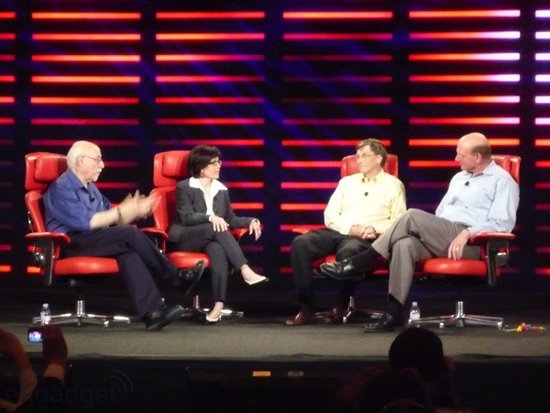 6:47 - Taking it back to the beginning, what kind of classmate/roommate was Bill in college? "He was a pretty shy guy... quiet, kind of shy, but a certain kind of spark. Especially later in the day, early in the morning. Bill was usually going to bed by the time I was waking up." Bill's talking about how he constantly played hookey.
6:50 - Ballmer talking about how Gates came and went Harvard. Gates: "You can leave and come back!" Say, is that a hint about Bills retirement? Ballmer's talking up his time spent at Procter and Gamble. Mossberg: Was it about then that you tried to hire Steve? Gates: "Not yet..." they were still way early on in the company.
6:53 - Mossberg: Did you wait to finish business school? Ballmer: "This is classic. Gates calls, 'Hey, what are you doing? Oh, god, too bad you don't have a twin brother or something...' he didn't just come out and say anything. 'Too bad, too bad -- and he hung up!' That was the sales call!"
6:54 - Gates on the early days: "We had so many customers, so many choices about what we could do next. We've always managed the company very conservatively." Talking anecdotally about how early-Microsoft wanted to have enough in the bank to pay its employees for a year if their customers stopped paying. "I had this very conservative view of our financial limits."
6:57 - Ballmer: "I wondered, why did I leave Stanford business school for this?" Eventually Bill gave him the real pitch: "We can put a computer on everyone's desk." Gates: "I needed Steve. I needed the skills he had, I needed a partner." Ballmer: "Bill said, 'Prove we can hire one good guy, and we'll hire 2-18'... and that became our management approach!" Ballmer says Microsoft hedges all its bets, takes all its risks technologically -- "Why take financial risks?"
7:03 - Mossberg: There's this perception that [Bill's] the technology guy, and [Steve's] the sales guy. Is that right? Bill: They've been jointly involved in a lot of crossover stuff, "Steve and I have done all this stuff together." Ballmer: Discussing working on the Windows 1.0 as a project manager. (Remember that infomercial?) "I'm not an engineer!"
7:04 - Swisher: Would you call yourself a businessman? Gates: "Sure. Sales minus costs equals profits. Is there more?" Big laughter. Mossberg: Did it bug you that Bill blew up and became extremely famous? Ballmer: "No. ... It was always clear Bill was the senior partner and I was the junior partner... it's never bothered me at all."
7:08 - Swisher: Do you still get veto on company decisions? Gates: "No." Says he's become the junior partner when he swapped roles with Ballmer. Mossberg asking about Bill's participation these days and going forward. "It's a very different role" he's taking on. Ozzie and Mundie have stepped up, and he's looking to Steve to help pick and choose his future projects.
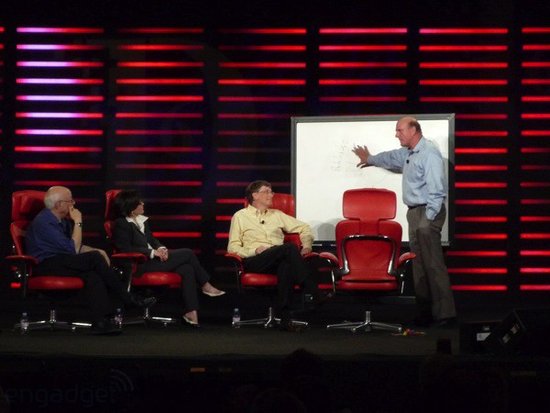
7:12 - Ballmer: "I want to know what [Bill] thinks." Swisher wants to talk Yahoo! Ballmer gives the quick rundown of events to date. "We are not rebidding for the company -- we reserve the right to do so, but it's not on the docket." Swisher: What are you interested in, in Yahoo? Ha, they're wheeling out a whiteboard for Ballmer to diagram his explanation. Swisher: "This is like crack for him." Ballmer discussing ads, bidders, search, and the scale of it all. "To accelerate scale, it made sense for us to look at Yahoo!'s business."
7:17 - Ballmer says they're still in talks with Yahoo! about a "partnership." Swisher mentions that Ballmer's model of competing with Google is reminiscent of a monopoly. Ballmer gives the who, me? look. Gates: "Guys like us avoid monopolies because we compete!" Naturally, the lot of that exchange was all very tongue-in-cheek.
7:20 - Ballmer: "You need scale, you need business and technology innovation. Large and small... this is a funny marketplace in which to say you're cheaper [than the competition]." Swisher: What's the key element" Ballmer: "The most important thing is that we have a good team and that we're patient." And money -- investment. Ballmer's getting super intense. Mossberg: "You're getting a little scary there." Ballmer: "WELL, YOU GOT THE REAL ME!" Dude, this is Steve, what do you want?
7:24 - Mossberg wants to talk Vista. "Is Vista a failure? Is it a mistake?" Ballmer: "It's not a failure, it's not a mistake. Are there things we'll modify and improve going forward? Sure." Gates is mum, smiling off into the distance. Bet he can't wait to wash his hands of this stuff.
7:26 - Ballmer: "Let me ask Bill..." is Vista up to your expectations compared to '95 and 3.0? Gates: "There's no product that we've ever shipped that was 100% of what I wanted. That's part of the magic of software, people give you feedback... and you get to make a new version. ... We have a culture of 'we need to do better."
7:28 - Ballmer: "There are two unique things: in a lot of our Windows releases in the past, we've always had a second stream. With 95 we were introducing NT in the background... the number one thing people found jarring [with Vista] was that we changed the UI. ... That was ironic." Mossberg: Will you show us a little bit of Windows 7? Ballmer: "Sure! This is the smallest snippet of Windows 7. It's just a small little snippet.'"
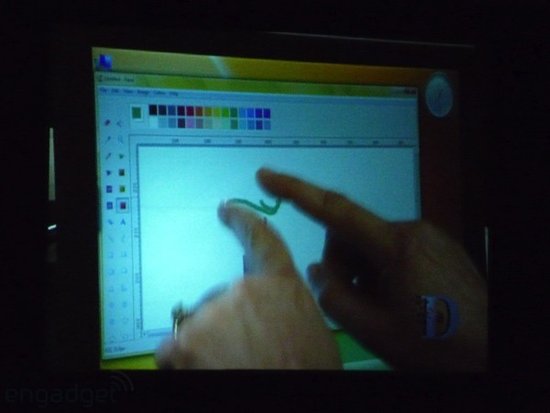 7:29 - "This is 'likely to ship within three years of general availability of Vista.'" Demo time! It does multi-touch!
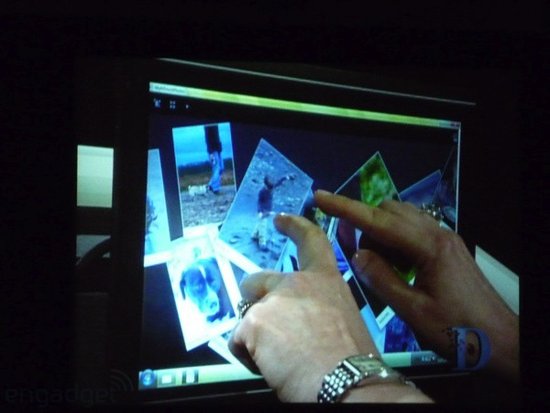 7:35 - They worked with the Surface team on the multi-touch stuff. Microsoft is re-thinking the whole user interface to better accommodate multi-touch for day to day use.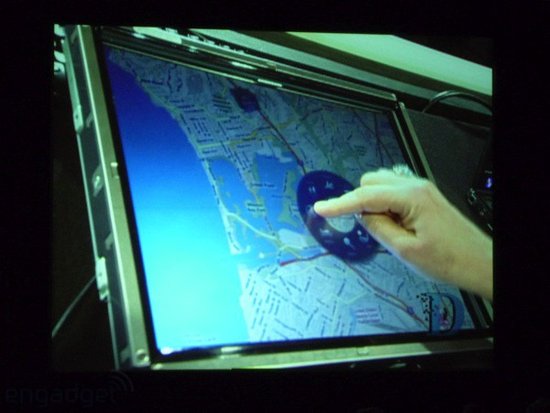
7:37 - Not running on surface. Running on a Dell Latitude XT. They've changed the taskbar, but it was difficult to tell exactly what they did.
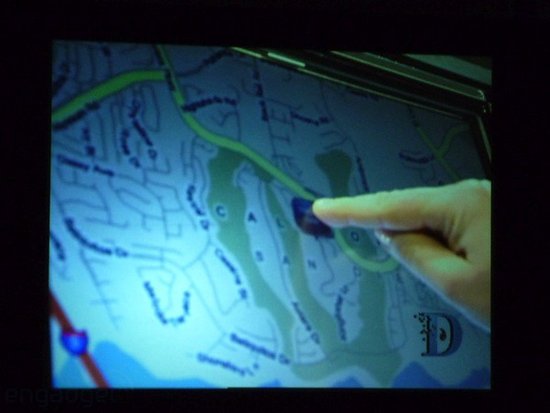 7:39 - Swisher and Mossberg: So, what does this represent? Is this the next phase of the way people will do day to day work on their computers? Gates: "We're at an interesting junction... in the years to come, the roles of speech, vision, ink, all of those will become huge. I showed what an intelligent whiteboard would be like."
7:43 - "For the person at home and the person at work, that interaction will change dramatically." Talking about the single-user interfaces we have today. Mossberg: This is 15-18 months from release, your friends in Cupertino probably have one more turn before you get this out the door. They have the iPhone, which is on the market today... is there a risk that the work you're doing here will look like they got there first? Ballmer: "There's a lot in Windows 7, and our goal's got to be, with our hardware partners, to produce fantastic PCs. ... We'll sell 270m PCs a year, and Apple will sell 10m. Apple is fantastically successful, and so are we."
7:45 - Ballmer's talking about Microsoft's "real opportunity" to improve things in the future -- which is another way of saying that things could be better, but there's no real specific commitment to making the Windows experience better.
7:47 - Mossberg's drilling Bill on the Mac vs. PC, Bill's reticent. Ballmer: "Every share point Apple picks up is a share point we don't like. ... But it depends on what your goal is. We like selling 290m units. ... Our model is better." Mossberg: But you CAN'T be happy with this Vista situation? Ballmer: "What's the appropriate response? I kind of like what Bill already said." Gates: "You're kind of repeating yourself." Ouch. Big applause.
7:51 - Q from the internet: Do you feel the unsuccessful pursuit of Yahoo! has tarnished Microsoft at all? Ballmer: "No. ... at very least, people now know we're serious about our online business."
7:53 - Talking about the phone market, Mossberg and Ballmer are debating unit volume between Nokia, RIM, Windows Mobile, Apple. On Android, Ballmer: "It's another person taking another crack at the pie. ... Google comes late, without experience, and no clear business model. ... But we take them seriously."
7:54 - Open floor for Gates as he transitions out of Microsoft: "It probably is the last time I'll get to speak here..." Nawwwwww. "Melinda will be speaking Thursday, you'll hear from here why this will be a fun journey."
7:58 - Audience questions, but unfortunately none have been all that interesting so far.
8:02 - O'Reilly: You set out to put a computer on every desk -- and you achieved that. So do you have a new audacious goal? Gates talking about the future and goals of how Microsoft thinks the future will look. Interactive TV, tablet PC, and so on.
8:08 - Question about apps in the browser, and what that means for the future of software. Ballmer doesn't think it's all or nothing.
Source